
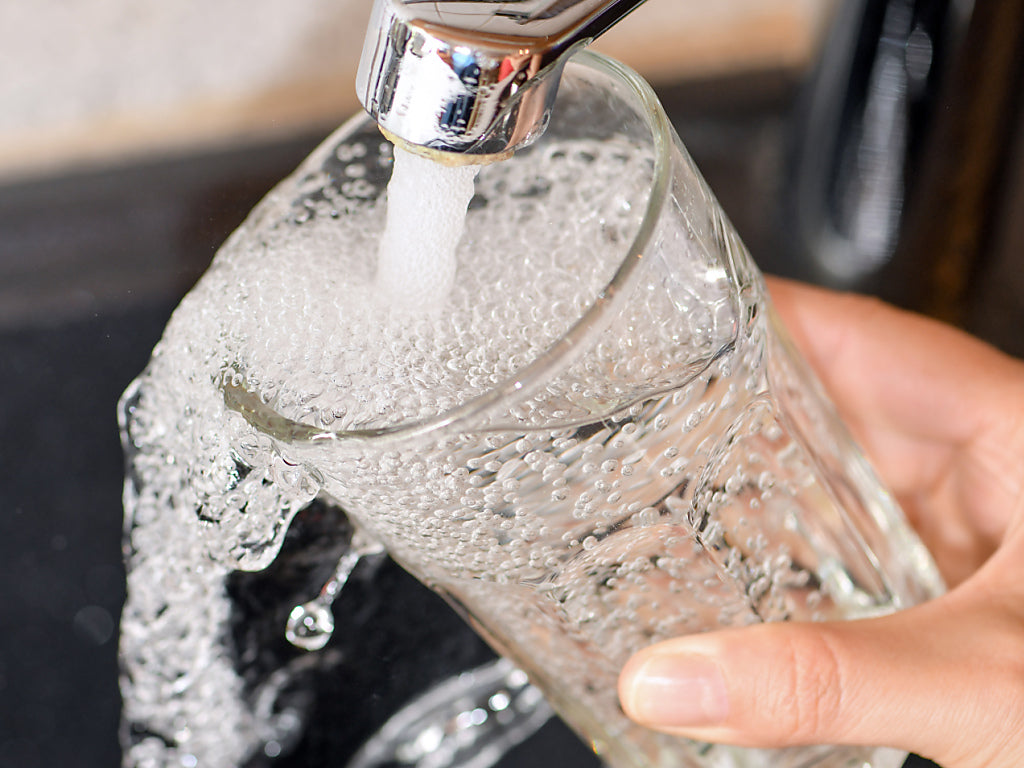

It flows endlessly, it's clear, it costs almost nothing. Tap water seems like the perfect solution. And yet, more and more households are asking: can I really trust it? Not out of paranoia, but because the reality of water treatment is more complex than we might think.
Controlled water, but not perfect
Let's be clear from the start: in Switzerland and most European countries, tap water is safe to drink. It's treated to strict health standards, regularly tested, and poses no immediate health risk. That's a real advantage, and it's worth acknowledging.
But "safe to drink" doesn't mean "pure". It means that measured contaminant levels stay below certain legal thresholds — thresholds that are themselves compromises between the ideal and the technical constraints of distribution networks.
The water you drink has taken a long journey before reaching your glass: captured from a spring or aquifer, treated at a station, chlorinated, then distributed through dozens or hundreds of kilometres of pipes. At every step, something can happen.
The journey of water to your tap
Water leaving the treatment plant is, at that point, relatively clean. But between the plant and your tap lies the distribution network — and that network is often old. Across Europe, many pipes are over 50 years old, with some sections dating back to the early 20th century.
Ageing pipes carry a risk of metal leaching. Lead is the most concerning: banned in new construction since 1948, it's still present in older networks. When water stagnates overnight or pressure varies, these pipes can release invisible particles into your water. Copper, used in many newer homes, can also migrate into acidic or stagnant water.
Chlorination: essential, but with side effects
Chlorine has been the cornerstone of drinking water disinfection for over a century. Effective against bacteria and viruses, it provides continuous protection throughout the network. Its use is necessary and justified.
But chlorine has its limits. Its taste and smell are noticeable to many. More importantly: by reacting with naturally occurring organic matter in water, it forms by-products called trihalomethanes (THMs), some of which are classified as possible carcinogens by the IARC in cases of prolonged exposure. Concentrations generally remain within regulatory limits, but those who drink tap water their whole lives are exposed daily — in their drinking water, coffee, pasta, and shower.
The invisible contaminants
Beyond chlorine and metals, water may contain other unwanted substances depending on the region: nitrates from intensive agriculture, pesticide residues, endocrine disruptors. Standard treatment plants are not designed to remove these so-called "emerging" micropollutants, and regulations struggle to keep pace with scientific discoveries.
Microplastics have now been detected in tap water across many European countries. Their presence is documented; their long-term effects on human health are still being evaluated.
The Pure Filters solution: purify, not just filter
It's precisely to address these limitations that Pure Filters purifiers were designed. Unlike simple activated carbon filters that only improve taste, Pure Filters purifiers use Coldstream FTO+ filters — a gravity purification technology independently tested and certified under NSF/ANSI protocols 42, 53 and P231.
No electricity, no plumbing, no water pressure required: water flows through the filter elements by gravity alone. Pure Filters purifiers work equally well on tap water or spring water — a rare versatility.
What Coldstream FTO+ filters remove: the official data
The figures below come from the official CF163W technical data sheet, tested by Envirotek Inc (NSF-accredited laboratory) at the rated capacity of 1,500 L.
| Contaminant | Reduction |
|---|---|
| Bacteria (Klebsiella terrigena) | 99.9999% (log 6) |
| Cysts and parasites | 99.9% |
| Microplastics (class 1) | 99.9% |
| Free chlorine | 99.9% |
| Chloramine | 99.9% |
| Nitrates | 98.2% (at start of life) |
| Nitrites | 99.9% |
| Fluoride | 97.5% (at start of life) |
| Lead | >99% |
| Copper | 97.7% |
| Arsenic | 88% |
| Pesticides & herbicides | >99% (for the majority of compounds tested) |
| Total trihalomethanes (THMs) | 90% |
| Volatile organic compounds (VOCs) | >99% for the great majority |
Note: certain reduction rates (chlorine, fluoride, nitrates) gradually decrease over the filter's lifespan — which is why Coldstream recommends replacement every 6 months or 1,500 L to maintain optimal performance.
An investment that pays for itself quickly
A Pure Filters purifier equipped with Coldstream FTO+ filters produces purified water at a cost far below that of bottled water, which costs €0.20 to over €1 per litre depending on the brand. A family that regularly buys bottled water can save several hundred euros per year — while dramatically reducing their plastic waste.
So, what should you do?
The goal isn't to demonise tap water, but to purify it effectively, simply, and sustainably. A Pure Filters purifier installs on a countertop in minutes, requires no plumber or electrical connection, and continuously produces purified, great-tasting water.
Discover all available models at pure-filters.shop — from the compact Voyager 6 L for 1–2 people to the Family 12 L for larger households.
Sources: Official Coldstream CF163W data sheet, tested by Envirotek Inc under NSF/ANSI 42, 53 and P231 — EU Drinking Water Directive 2020/2184 — WHO, Guidelines for Drinking-water Quality — IARC, Monographs on disinfection by-products.